

June 10, 2026
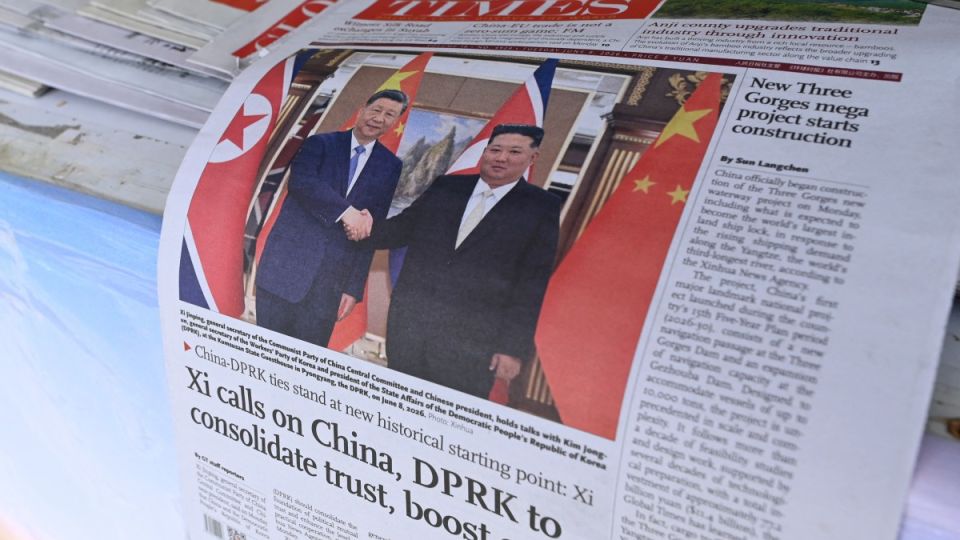
SEOUL – Great powers often visit smaller allies when they are least certain of their influence. Chinese President Xi Jinping’s visit to Pyongyang on Monday and Tuesday appears to confirm the growing alignment among China, Russia and North Korea.
Yet the timing of Xi’s visit, his first in seven years, suggests something more complicated. Xi arrives only weeks after separate summits with US President Donald Trump and Russian President Vladimir Putin, and as North Korea moves ever deeper into Moscow’s strategic orbit. Xi’s visit appears less a celebration of unity than an exercise in management.
For Beijing, North Korea remains an indispensable buffer on China’s northeastern frontier, but it is no longer a client dependent on China alone. Military cooperation with Russia has expanded sharply since the Ukraine war, highlighted by North Korean troops marching in Moscow’s recent Victory Day parade.
What appears from afar to be a seamless authoritarian triangle may look rather different from Beijing. China benefits from partnership with Russia, but it has little interest in watching Moscow become Kim Jong-un’s primary external patron.
That concern helps explain why Xi arrives in Pyongyang after meeting both Trump and Putin. China is seeking to reaffirm itself as the indispensable gatekeeper of Korean Peninsula affairs. If future US-North Korea diplomacy resumes, Beijing wants a seat at the table.
Encouraging dialogue between Washington and Pyongyang could loosen ties between North Korea and Russia without forcing China into direct confrontation.
Economic interests add another layer. Discussions on access to the lower Tumen River and transportation links to the East Sea would deepen North Korea’s integration into China’s economic orbit at a moment when Russian influence is growing.
The most sensitive issue remains North Korea’s nuclear program, and Pyongyang has already tried to define the terms of discussion. Days before Xi’s arrival, North Korea publicized an expanded uranium enrichment facility and claimed that weapons-grade nuclear material production had more than doubled over the past five years.
Kim Yo-jong, the powerful sister of Kim Jong-un, reinforced the message by declaring North Korea’s nuclear status irreversible in a statement released on Saturday. The signal was directed not only at Washington and Seoul, but also at Beijing: Nuclear weapons are not up for negotiation.
China’s own position has consequently become more ambiguous.
Following Xi’s recent summit with Trump, the US said the leaders reaffirmed the goal of denuclearization. After Xi met Putin, public statements focused on opposition to sanctions and military pressure, while denuclearization was absent.
This divergence reflects a reality Beijing may be reluctant to acknowledge openly. Complete denuclearization has become increasingly detached from events on the ground. China appears less focused on eliminating North Korea’s arsenal than on preventing its further destabilizing use.
That calculation carries risks for Beijing itself. The regional security environment is changing rapidly. The Trump administration’s emphasis on burden-sharing has pushed allies to assume greater responsibility for their own defense.
South Korea is expanding defense exports and exploring advanced security cooperation with Washington. Japan continues its own military buildup. From China’s perspective, a permanently nuclear North Korea may cease to be a strategic asset if it accelerates military competition across Northeast Asia.
For Seoul, Xi’s visit should be viewed neither with alarm nor with misplaced optimism. Beijing’s interests and Seoul’s concerns overlap more than either side publicly admits. A stable peninsula, not an unchecked nuclear arms race, remains the outcome most consistent with China’s long-term interests.
Xi’s return to Pyongyang is therefore not the beginning of a new bloc. It is an attempt to preserve an increasingly delicate equilibrium. Seoul’s diplomacy should focus on turning China’s fear of a more heavily armed Northeast Asia into leverage for a more responsible approach toward North Korea.