

June 30, 2026
ISHINOMAKI – Kento Suzuki, 12, and his 9-year-old sister, Hana, went to school as normal in Ishinomaki, Miyagi Prefecture, on March 11, 2011, but they never came home. The siblings were among the 74 children and 10 teachers at Okawa Elementary School who were lost in the tsunami triggered by the Great East Japan Earthquake.
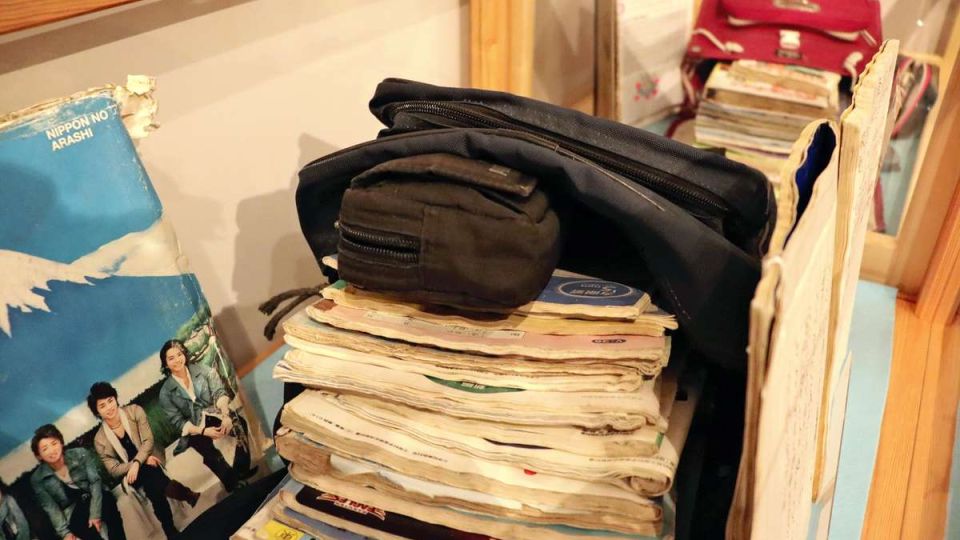
Fifteen years later, the school bags that belonged to Kento and Hana have gone on display at the Meet Kadonowaki education and exhibition venue in Ishinomaki. The children’s notebooks and textbooks, damaged by the water of the tsunami, and their pencil cases are also part of the display, and their parents hope the items will remind visitors how precious life is.
Kento was in the sixth grade of elementary school when he died in the tsunami. Hana, who was in fourth grade, was swept away and remains missing.
Courtesy of Miho Suzuki
Siblings Kento, left, and Hana got along well, as shown in this photo from June 2009.
The children’s father, Yoshiaki, found Kento’s school bag on a wooden plank in a swamp about a kilometer from the school 10 days after the disaster. The bag was caked with mud, making it extremely heavy.
The bag was filled with textbooks, as well as a book about Arashi, a pop idol group that Hana liked. It seems Kento had borrowed the book from the school library. “That was a Friday,” the children’s mother, Miho, recalled. “I guess Kento thought that Hana could take her time reading the book over the weekend.”
The Yomiuri Shimbun
Miho Suzuki, left, and her husband, Yoshiaki, talk about their children, who were both lost in the tsunami triggered by the Great East Japan Earthquake on March 11, 2011.
Hana’s backpack was found on the school’s roof five days after the disaster. It contained her textbooks and notebooks, a reading record card that had been filled in up to March 10, and her pencil case, which had a cherry motif. All these items are also on display.
Hana’s school bag had been displayed at the Okawa Tsunami Memorial Hall, which is adjacent to the school, since 2022. A moving sentiment was behind that exhibit. “We want people to know that our daughter didn’t come home that day, although we do have her backpack,” said Miho.
Kento’s backpack had been kept in a children’s room in the family’s newly built home in Higashi-Matsushima in the prefecture. For a long time, Kento’s parents could not bring themselves to look at the notebooks inside his bag.
“Before I realized, 15 years had passed. I thought it was about time to take a look,” Miho said. In December 2025, Kento’s parents decided to finally open his school books.
In his notebooks, Kento had written potential questions for an interview at the private junior high school he was scheduled to attend from that spring, along with answers he might give. “I want to become an X-ray technician,” Kento had written. His other comments included, “My home doesn’t have good access to public transportation, so if I end up going to your school, I’ll commute from my grandfather’s house.”
In the autumn of his sixth-grade year, Kento told his parents that he wanted to take the junior high entrance exam to fulfill his dream. They bought some workbooks, and Kento diligently studied with them in the living room. He passed the exam two months before the disaster struck.
“His hard work getting ready for the exam is proof that Kento lived,” Yoshiaki said as he looked at the notebook. “I’d like everybody to know that.”
Such feelings spurred the Suzukis to go ahead with the exhibition of their children’s school belongings.
The two school bags will be displayed together until early August. The bags will then be exhibited separately at the Meet Kadonowaki facility and the Okawa Tsunami Memorial Hall. For both parents, the displays have a deeper significance.
The Suzukis expressed their hope that people will learn not just about the damage caused at Okawa Elementary School, but also about the daily lives of the children who went there, with an emphasis on saving lives in the future.