

May 12, 2026
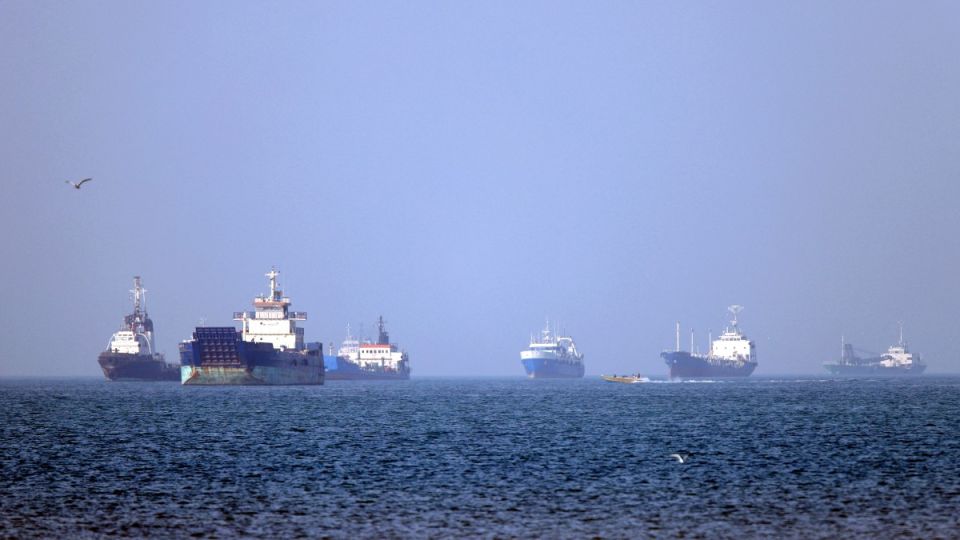
SEOUL – South Korea’s presidential office on Monday strongly condemned the attack on the Panama-flagged cargo vessel HMM Namu in the Strait of Hormuz, while maintaining a cautious stance on identifying who was responsible for the strike as further investigations continue.
National security adviser Wi Sung-lac said attacks on civilian vessels “can neither be justified nor tolerated,” but stressed that the government had yet to determine the source of the attack or the exact type of airborne objects involved.
“Our government maintains that attacks on privately operated vessels, including the HMM Namu, can neither be justified nor tolerated, and we strongly condemn them,” Wi said during a press briefing at Cheong Wa Dae.
He added that authorities were conducting an additional analysis to identify the actor behind the attack, as well as the exact type and physical characteristics of the unidentified airborne objects that struck the vessel.
“We will take corresponding measures based on the results,” Wi said, while emphasizing that the government remained in the process of determining responsibility.
The remarks reflected Seoul’s continued caution despite growing domestic political pressure and speculation surrounding the attack.
The presidential office said it currently viewed the possibility of sea mines or torpedoes being involved as low, citing the pattern of the damage to the vessel.
“Considering the damage pattern caused by the blast pressure and the shape of the penetration area, the possibility of a strike by mines or torpedoes appears low,” Wi said. “Further investigation is needed to obtain more accurate information regarding the airborne objects.”
The comments came a day after the Foreign Ministry said Sunday that a joint government investigation had found that two “unidentified airborne objects” caused the explosion and fire aboard the vessel operated by South Korean shipping company HMM on May 4.
The HMM Namu, operated by South Korean shipping company HMM, had been stranded in the Strait of Hormuz amid ongoing regional tensions. A seven-member government investigation team boarded the vessel after it was towed to Dubai of the United Arab Emirates on Friday. The recent attack left a 7-meter-wide rupture in the hull.
The HMM Namu was carrying 24 crew members, including six South Koreans. No casualties were reported.
Wi said the government would strengthen communication with related countries and step up efforts to ensure the safety of South Korean vessels and crew members operating near the Strait of Hormuz.
“We will continue participating in international efforts aimed at ensuring the security and safe passage of all vessels, including South Korean ships,” he said.
A senior Cheong Wa Dae official, requesting anonymity, said authorities had initially withheld judgment because early reports indicated there was no flooding and the ship had not tilted, making it difficult to immediately conclude that the vessel had been attacked.
“It was not that we viewed the possibility of a strike as low,” the official said. “At the initial stage, we simply reserved judgment on whether the vessel had been struck.”
The official added that it remained difficult to predict when the additional investigation would be completed.
“We will try to reach a conclusion as quickly as possible,” the official said.
The presidential office stressed that it was not yet in a position to identify any specific country as being responsible for the attack.
“Whether Iran had any involvement remains unknown at this stage,” the presidential office official said. “No particular country has been identified, and we are examining various possibilities.”
The Foreign Ministry continued to emphasize the need for caution pending further analysis. Foreign Minister Cho Hyun on Monday said additional examination was required regarding last week’s strike.
“There are still issues that require closer examination, and any judgment will need to be made after a careful review,” Cho told reporters Monday while arriving at the Government Complex Seoul.
The ministry said authorities were continuing a detailed examination of engine fragments collected at the scene, adding that they had not yet determined the origin of the airborne objects.
The government’s cautious approach came despite mounting political pressure following US President Donald Trump’s earlier claim that Iran had “taken some shots” at the HMM vessel and other targets. Tehran has denied any involvement.
When asked why the government had called in Iranian Ambassador to South Korea Saeed Kouzechi following the release of the investigation results, Cho said Seoul deemed it necessary to convey the findings to Tehran, adding that the United States had also been informed of the outcome of the probe.
The incident took place shortly after Washington launched “Project Freedom,” an operation intended to assist vessels stranded in the Strait of Hormuz. The operation was suspended the next day on May 5. Tehran condemned the move at the time, arguing it violated the ceasefire in effect since early April.
The issue has since become politically charged in Seoul, with rival parties on Monday clashing over whether the government responded too slowly or with appropriate caution.
Lawmakers from the main opposition People Power Party accused the government of downplaying the attack and missing the “golden time” for a stronger response.
Rep. Kim Gunn, the People Power Party’s ranking member on the National Assembly Foreign Affairs and Unification Committee, criticized inconsistencies in the government’s early messaging, noting that the Ministry of Oceans and Fisheries initially referred to a “suspected strike,” while the Foreign Ministry later described the incident only as “a fire accompanied by an explosion.” The two ministries have taken the lead in handling the incident.
“Despite clear signs of an attack, the government failed to clearly define the incident as such,” Kim said during a press conference held at the Assembly in the morning.
People Power Party lawmakers also questioned why parliamentary committee sessions had not yet been convened, accusing the government of avoiding tougher diplomatic action despite attacks on a South Korean-linked vessel.
The opposition further pointed to responses by other countries following attacks on their assets, noting that France deployed an aircraft carrier after one of its vessels was struck, while India and Thailand summoned their respective Iranian ambassadors to lodge protests.
The ruling Democratic Party of Korea rejected the criticism, accusing the People Power Party of politicizing a sensitive security issue before the facts had been fully established.
Ruling party lawmakers said the government’s investigation had confirmed impacts from unidentified airborne objects, but it stressed that the launch source, type and size of the devices had not yet been determined.
“Prematurely identifying an attacker without clear scientific evidence would itself be reckless and dangerous, especially while 26 South Korean-linked vessels remain in the area,” Democratic Party lawmakers on the National Assembly’s Foreign Affairs and Unification Committee said via joint statement read at a separate press conference.
They argued the government’s priority should remain the safety of South Korean nationals and vessels still stranded in the Persian Gulf.
Security experts said the available evidence increasingly pointed to a deliberate external strike rather than an accident or internal malfunction.
Yu Ji-hoon, a researcher at the Korea Institute for Defense Analyses, said the pattern of damage appeared more consistent with airborne explosive devices targeting a vulnerable section of the ship.
“In particular, the fact that two unidentified airborne objects struck the upper section of the port-side ballast tank near the stern at roughly one-minute intervals suggests the possibility of a deliberate, limited precision strike targeting a vulnerable area, rather than an accidental collision or simple mishap,” Yu said.
He added that the devices may have been explosive-laden uncrewed aerial vehicles, small cruise-type projectiles or low-altitude airborne systems designed for maritime attacks.
“The strike location was near the upper part of the hull, and the blast impact appears to have affected both the vessel’s structure and engine room systems, suggesting the objects approached above the water surface or at extremely low altitude before colliding and exploding,” Yu said.
Yu also noted that the short interval between the two impacts suggested the attack may have been intended to disable the vessel rather than sink it.
“This raises the possibility that the first strike was intended to cause structural damage and confusion, while the second was aimed at amplifying the damage or disabling the vessel’s ability to navigate,” he said. “Rather than attempting to sink the ship outright, the attack appears to have been intended to render it inoperable while maximizing political and psychological pressure through a limited strike.”
Meanwhile, HMM plans to seek compensation for repair costs through the vessel’s war-risk insurance coverage, industry sources said Monday.
The company said repairs to the HMM Namu are expected to take at least one to two months, though the insurance policy does not cover losses stemming from suspended operations during the repair period.
The vessel’s war-risk coverage amounts to approximately $65.3 million and is jointly underwritten by five South Korean insurers led by Hyundai Marine & Fire Insurance.
The HMM Namu, a newly delivered 38,000-deadweight-ton multipurpose cargo vessel, had completed its first commercial delivery to Saudi Arabia before becoming stranded near the Strait of Hormuz upon its closure.