

January 8, 2026
SEOUL – South Korean President Lee Jae Myung said Wednesday that he has asked China to help convey Seoul’s “genuine intent” on denuclearizing the Korean Peninsula to North Korea, emphasizing Beijing’s potential role as intermediary.
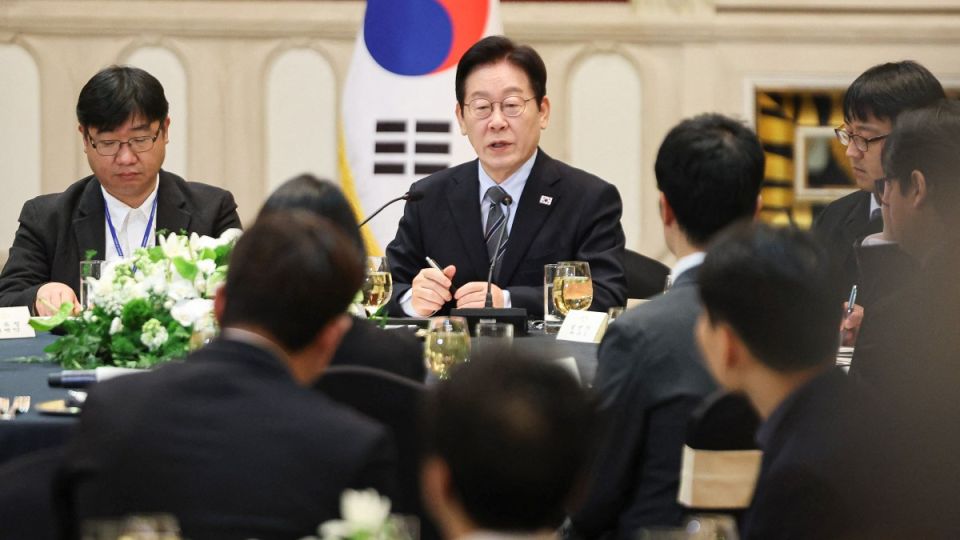
“North Korea and (South Korea) are in a situation where all routes are blocked, and the trust level is at zero,” Lee told a group of Korean reporters in Shanghai following his Monday summit with Chinese President Xi Jinping. “In that context, I proposed to President Xi that it would be helpful if China could act as a mediator for peace on the Korean Peninsula.”
Lee confirmed that the request was made during extensive discussions in Beijing focused on regional stability and ways to ease enduring tensions over North Korea’s nuclear and missile programs.
Lee reiterated South Korea’s commitment to a phased approach to denuclearization.
“We believe the first step should be halting additional nuclear material production and then moving toward reductions step by step,” Lee said. “Our ultimate goal is a nuclear-free Korean Peninsula. This is not a policy for political show, but a sincere strategy for peace.”
While specific details on how China might communicate Seoul’s position to Pyongyang were not immediately available, Lee said Chinese officials responded positively to the idea of taking on a larger role.
“The Chinese side said they would try to make efforts and asked for patience,” Lee said, adding that he sensed “a degree of agreement from Beijing on the need to resume dialogue with North Korea.”
Speaking in Shanghai, Lee stressed that public understanding would be essential if diplomacy with the North is to progress.
“Denuclearization cannot happen overnight,” he said. “What matters is consistency, creativity and trust-building. If China can help explain our position faithfully to the North, it could open new possibilities.”
Lee’s appeal to Beijing comes as Pyongyang appears to be navigating a more complex geopolitical landscape marked by deepening cooperation with both China and Russia.
Recent reporting indicates that North Korea is seeking to consolidate improving ties with China while also sustaining cooperation with Russia, even as it remains isolated from much of the international community.
North Korea’s leadership under Kim Jong-un has celebrated closer military and political ties with Russia, including strategic partnership agreements and personnel exchanges, and analysts note that such cooperation gives Pyongyang added diplomatic flexibility and potential leverage in its dealings with Beijing.
The request to Beijing also comes as Seoul and China are working to normalize bilateral ties across multiple fronts following the political fallout of South Korea’s 2016 deployment of the US Terminal High Altitude Area Defense antimissile system.
Against the backdrop, Lee emphasized the need for sustained high-level engagement to manage tensions surrounding North Korea.
“South Korea and China share a common interest in preventing conflict on the peninsula,” Lee said. “Denuclearization, alliance coordination and regional diplomacy should never be shaken by emotion or politics.”
“We will move forward gradually, step by step, in a way that benefits both sides,” he added.
China’s West Sea structures
In addition to denuclearization, the leaders’ 90-minute meeting in Beijing covered a range of sensitive security concerns.
Among the issues discussed was China’s unilateral installation of structures in the Provisional Measures Zone, a jointly managed area in the West Sea established under the 2000 Korea-China Fisheries Agreement.
Seoul and Beijing further agreed to work toward holding “vice minister-level talks on the delimitation of maritime economic zones in the West Sea” this year, as part of efforts to prevent misunderstandings in waters where the maritime boundary remains undefined.
Lee has repeatedly called for regularized search-and-rescue exercises between the two navies on humanitarian grounds, noting that “large-scale maritime accidents can occur suddenly near boundary areas.”
“I told them that in such cases we should not argue over history or borders, but act together to save lives,” Lee said in Shanghai. “I have not yet received an answer, but I hope discussions will continue.”
Asked about the possibility of Seoul mediating escalating frictions between Beijing and Tokyo — including China’s recent export controls on dual-use goods to Japan — Lee tread cautiously and said South Korea’s room to maneuver was limited for now.
“At this stage, what we can do appears very limited,” Lee said. “Intervening when adults are fighting for real reasons can lead to being disliked by both sides.”
He added that Seoul would act only “when our role becomes necessary and truly effective,” while continuing to closely monitor the situation for any impact on Korea’s own exports and regional supply chains.
During the summit, Lee and Xi agreed to gradually expand cultural content exchanges that had been restricted in China for years, even as Beijing officially denied the existence of any “Hallyu ban.”
“China has maintained that cultural exchanges should be healthy and beneficial,” Lee said Wednesday. “But there was a difference in expression this time, and I think both sides better understand the need for an orderly, phased solution.”
Quoting President Xi, Lee added that the Chinese leader remarked, “Ice does not freeze to three feet overnight, so can it all melt at once? Fruit ripens and falls only when the time is right.”
Lee interpreted the comments as a signal that “concrete consultations will continue at the working level.”
Lee arrived in Shanghai from Beijing on Tuesday afternoon for a series of political and economic programs.
South Korea’s president came to the Chinese metropolis to pay tribute at a historic site linked to Korea’s provisional government-in-exile and later attended a business networking event in the commercial hub. He held a courtesy meeting with Chen Jining, Shanghai Municipal Party secretary, followed by a welcome dinner that focused on expanding exchanges between regional governments and cooperation on preserving sites related to Korea’s independence movement.
On Wednesday, Lee attended the Korea-China Venture Startup Summit, meeting entrepreneurs from venture firms and startups of both nations. He also visited the former Shanghai headquarters of Korea’s provisional government during Japan’s colonial rule to mark the centennial anniversary of its establishment this year.