

December 3, 2025
SEOUL – The National Assembly on Tuesday approved a budget for 2026 — the first under the Lee Jae Myung administration — after the rival parties reached a last-minute agreement on the final day of the statutory review period.
Tuesday’s vote marks the first on-schedule passage of a national budget in five years, since 2020.
The 727.9 trillion won ($495 billion) budget, passed during a plenary session Tuesday night just minutes before the legal deadline, is about 1 trillion won smaller than the government’s original 728 trillion won proposal. The adjustment reflects 9.3 trillion won in cuts and 9.2 trillion won in additions made during the parliamentary review process.
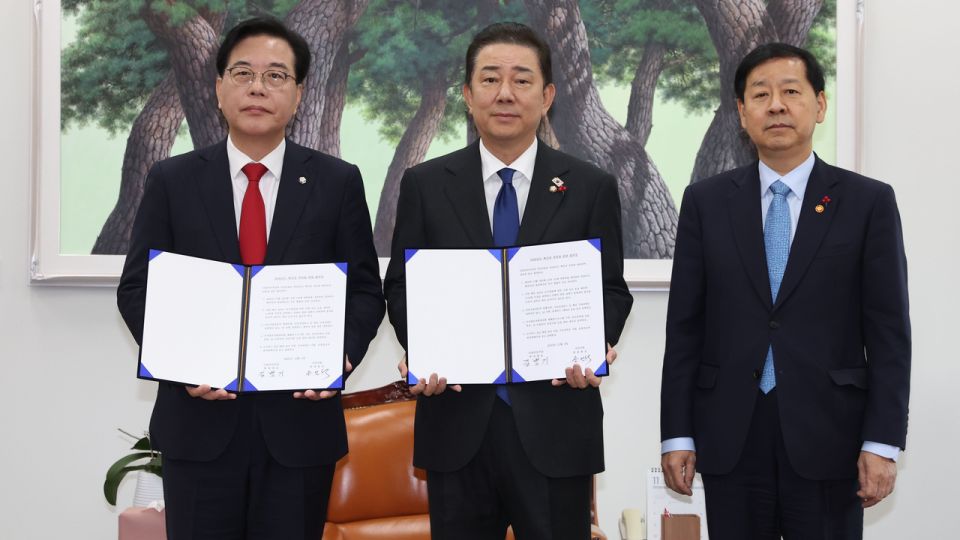
The breakthrough came after the floor leaders of the two main parties — Rep. Kim Byung-kee of the ruling Democratic Party of Korea and Rep. Song Eon-seog of the main opposition People Power Party — met earlier in the day and agreed to process the 2026 budget along with related revenue bills and supplementary legislation.
The agreement trims 4.3 trillion won from President Lee Jae Myung’s proposed 728 trillion won budget. By permitting only targeted increases within that reduced amount, total expenditure remains at or below the original proposal.
The reductions affect AI-related support programs, policy funds and reserve funds, among others.
At the same time, funding has been increased to rebuild the state-run data center in Daejeon that caught fire in September and to develop nationwide distributed power grids. Additional increases go toward expanding city gas pipeline installations, national scholarships and veterans’ honor allowances.
Key Lee administration policy programs remain intact. These include support for issuing local spending vouchers and funding for the National Growth Fund and a large-scale policy fund designed to inject a total of 150 trillion won over five years into advanced industries such as artificial intelligence, semiconductors and biotechnology.
Rep. Lee So-young of the Democratic Party, who serves as executive secretary on the Assembly’s Special Committee on Budget and Accounts, previously said the restructuring keeps overall spending within the reduced total to help address concerns over fiscal soundness.
“There is no net increase in total spending,” she said, adding that the final budget set to pass the Assembly “will show some improvement over the government’s draft in terms of fiscal discipline.”
Meanwhile, Song of the People Power Party said during a party meeting on Tuesday morning, “We agreed to the deal in a spirit of broad compromise because the livelihood budget is too important to delay past the deadline.”
Song added that the negotiations had been difficult, saying, “The majority party has used its numerical advantage to push ahead unilaterally, without any consideration or respect for the minority. It has been an extremely difficult situation for us.”
“There will be lingering regrets for myself and for many of our lawmakers,” he said.