

February 5, 2026
LAHORE -After years of silence, Basant returns, and Lahore’s kites wait — patient, hopeful, and ready to lift the city’s spirit once more.
In the ancient city of Lahore, where the Ravi river whispers secrets to the minarets of the Badshahi Mosque, spring arrives not with a gentle sigh, but with a sudden, jubilant roar.
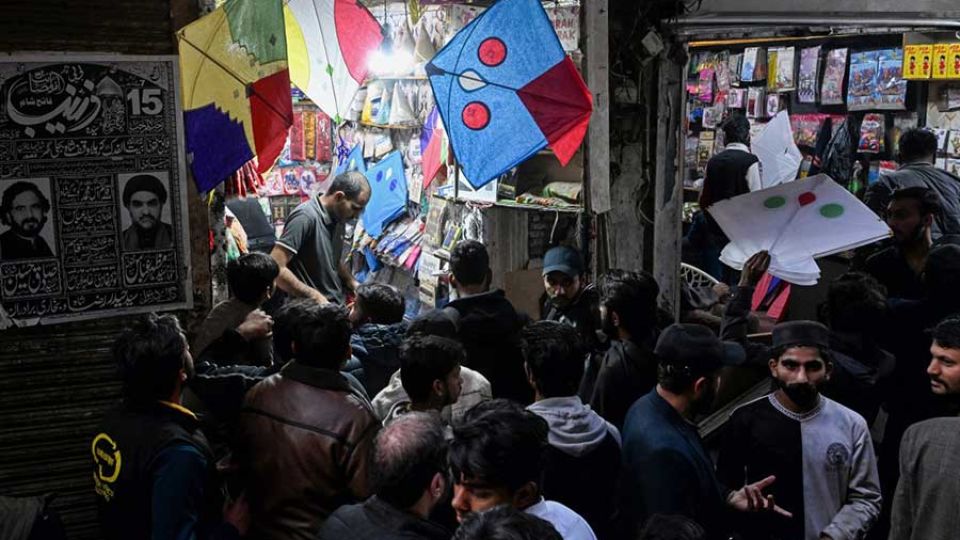
When the winter’s fog finally yields to the sun’s warm gaze, the skies above the walled city awaken. Kites (‘patangs’) burst upward from rooftops, their paper bodies trembling, their tails slicing the blue sky like calligraphy in motion.
This is Basant: a centuries-old festival marked by marigold blooms and kites, carried by colour and the steady pull of the wind.
Bo Kata! — a festival of freedom and flight
Basant traces its roots to Vasant Panchami, the ancient herald of spring observed on the fifth day of Magh, when the land stirs from winter’s slumber. In the mustard fields of Punjab, ochre blooms unfurl like carpets laid for spring’s arrival. Goddess Saraswati, (the goddess of learning and the arts), clad in saffron-gold, is invoked with music and learning, her veena (an Indian stringed instrument) resonating with the promise of renewal.
In Lahore, however, Basant long outgrew its ritual origins. It became deeply Punjabi, exuberantly urban, and radically inclusive. Hindu, Muslim and Sikh households alike climbed their roofs, dressed in amber and marigold hues, turning the city into a living mosaic where faith receded, and celebration took flight.
Historical chronicles recall Basant at its most magnificent during the Mughal era. Emperors revelled in the spectacle: kites wheeling above the ramparts of Lahore Fort, their strings guided by hands adorned with henna. Amir Khusrau, the Sufi poet whose verses still seem to linger in the city’s breath, sang of Basant as a season of love, colour, and divine intoxication.
Later, in the court of Maharaja Ranjit Singh, the festival assumed an even grander, almost theatrical form. For 10 days, Lahore became a city lost in celebration. Marigold garlands draped streets and courtyards; soldiers appeared in turmeric-hued turbans; women swayed on jhulas (swings), the steady beat of the dhol travelled through every lane. Above it all, kite battles drew cheers of “Bo kata!” from rooftop to rooftop.
Yet the true poetry of Basant lies not in its pomp, but in the humble kite itself. A fragile diamond-framed paper and bamboo, it is tethered to earth by a single string, yet it yearns for the heavens. In the hands of a Lahori child or elder, the patang becomes more than play: it is an act of transcendence. As the wind takes hold, the kite escapes the dust and clamour of crowded streets, briefly escaping the confines of class and circumstance, carrying the hopes of those who hold the string below.
For many in Lahore, Basant has always been this quiet rebellion against gravity. In narrow streets where life presses close, the rooftop becomes a stage for liberation. A young man, burdened by tomorrow’s worries, sends his kite aloft and watches it soar, higher, freer, until it seems to touch the very edge of possibility. A woman, her heart full of unspoken longings, lets the wind carry her kite as if it could bear her dreams to distant horizons.
The kite is an escape made visible: fragile yet defiant, tethered yet boundless. It reminds us that even the smallest soul can touch the infinite if given the right wind.
The ghost of Basant lingering in memory for two decades
For nearly two decades, however, the skies remained silent. The ban descended after tragic losses, lives claimed by sharp, glass-coated or metallic strings that sliced through the air, severing throats and injuring bystanders on rooftops and streets below.
The silence was born of necessary grief and reckoning, a painful but essential pause to protect what mattered most.
Families who once gathered with spools of thread in their hands now looked up at an empty blue sky, feeling the absence like a missing heartbeat. Old men sat on charpoys in the evenings, eyes distant, murmuring about days when the sky was alive with colour. Mothers recalled their children’s laughter as they ran across terraces, cheeks flushed with sun and excitement. Young people, who had known Basant only through stories and grainy videos, carried a quiet nostalgia for something they had never truly touched.
The city missed it deeply: the shared joy, the playful rivalries, the way the wind seemed to carry away every worry for a single radiant day. Basant had become a beloved ghost, lingering over rooftops and in memory.
But the longing never died. It lived in whispered conversations, in turmeric-hued kurtas worn on spring days as quiet tribute, in the careful way kite-makers kept their craft alive in the city’s hidden corners. It lived in the hope that one day the skies would fill again — not recklessly, but with wisdom earned from sorrow.
Lahore’s patangs are set to rise once more, responsibly
And now, as February has ascended, the wind is stirring once more. Under the Punjab Regulation of Kite Flying Ordinance, 2025, with its strict mandates for cotton strings only (no metallic or glass coatings), QR-coded registration, maximum nine threads, drone monitoring, and zero tolerance for violations, the patangs will rise again, thoughtfully and safely, over the rooftops of Lahore on February 6, 7, and 8, 2026.
The old songs are being rehearsed, the dhol awaits its beat, and the air will soon carry the sweet scent of marigold sweets and the gentle tug of ordinary thread. What was lost is being remembered with care; what was mourned is being welcomed back, wiser and more precious for the wait.
As one lifelong resident of Anarkali, Anwar Bajwa, shared with quiet emotion:
“Basant was never just a day for me; it was part of who I was, part of every spring morning when the air turned warm and full of promise. As a boy, I would wake before dawn and run to the rooftop with my siblings, thread in hand, my heart racing for the wind to lift our kites. Those patangs were my companions, my secrets, my way of whispering dreams to the sky when words fell short. Every tug on the string felt like my own heartbeat reaching higher.”
He added that when the rooftops went silent, “it was like losing a piece of my childhood. The empty sky in spring felt wrong, heavy, and incomplete. Now, hearing that the kites will fly again, safely and responsibly, I feel that old excitement stirring inside me, like time has turned back and I’m that boy once again, waiting for the wind to carry my dreams up where nothing can touch them.”
The skies of old Basant were tapestries of scarlet, emerald, indigo, and amber, woven by thousands of patangs locked in gentle combat. Rooftops brimmed with laughter, the air thick with the scent of marigold-hued sweets. Families gathered, strangers became friends, and for radiant days, Lahore was united in pure, unbridled joy.
The kite, too, carries its own quiet symbolism. A close look reveals intricate designs — stars, eyes, flowers — each patang a small work of art, born in the hands of artisans who know the wind’s secrets.
And beneath it all, the earth itself celebrates: vast fields of mustard-gold sway in the breeze, a living mirror to the crowds above.
The return of flight and soaring spirits
As the season approaches, the memory of those quiet years only deepens the anticipation. The skies have been empty for too long, yet the longing has made every coming flight more sacred.
In every Lahori heart, the kite still waits, patient, hopeful, and soon it will rise once more.
When it does, Lahore will not merely remember joy; it will reclaim it, wiser for the silence, stronger for the lessons etched in loss. Basant returns not as a fleeting spectacle, but as proof that even after the darkest pause, the human spirit, fragile as paper and defiant as wind, can ascend again, tethered only by the thinnest thread of care, soaring toward a boundless sky that belongs, once more, to all of us.