

December 22, 2025
TASHICHOLING – For generations, sheep rearing has shaped the lives of highland communities in Samtse, passed from parents to children as both a livelihood and a traditional practice tied to seasonal movement.
Flocks once roamed the northern border, grazing across common lands that stretched from village farms to forested slopes and high mountain ranges.
Herders followed a seasonal migratory pattern, climbing to higher altitudes during dry months and returning to villages after harvest.
Today, the practice continues on a far smaller scale. Fewer households participate, grazing land has shrunk, and labour has become scarce, leaving herders uncertain whether the tradition will survive the next generation.
Only four major sheep rearers remain in Samtse, scattered across Norgaygang, Namgaycholing, Pemaling, and Tendruk, an indication of a once-widespread occupation in decline.
Sheep rearing provides more than income. It also maintains a presence in remote border areas, a factor linked to national security, while wool from the flocks is supplied to local weavers, connecting the traditional practice to community crafts and industries.
However, managing flocks has become increasingly difficult as grazing areas shrink and fewer people are willing to work under conditions that involve long periods away from settlements.
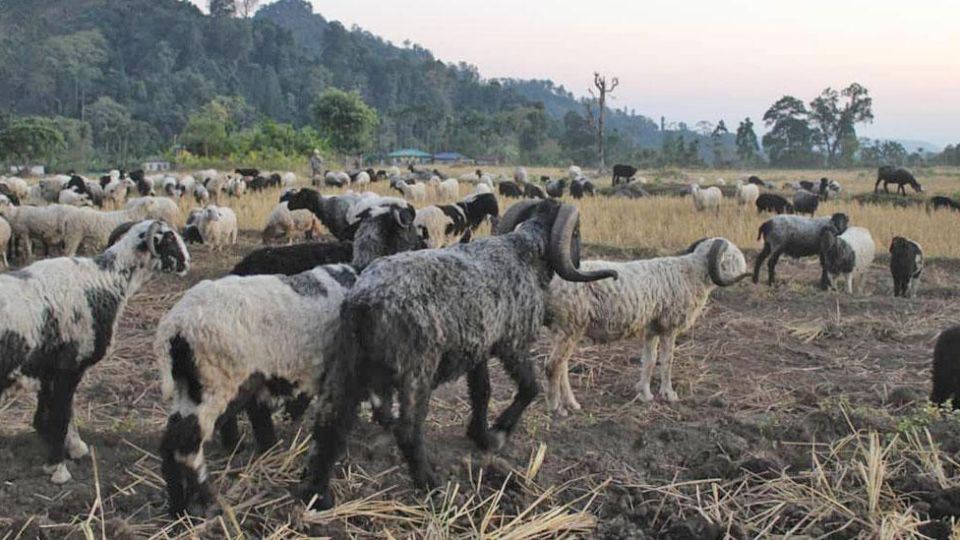
Gita Gurung, 51, from Pemaling, manages 250 sheep, including adults and lactating animals, representing the fifth generation in his family to carry on the practice.
“When the flock moves to villages, it can stay only two or three days because the land cannot feed all 250 animals for long,” he said.
He once had more help, but a shortage of herders has made management more challenging. Three assistants help him now, though farmland and cash crops severely limit grazing space.
Earlier, he had more people to assist; however, the current shortage of herders has made management more challenging. Three assistants help him, but farmland and cash crops limit grazing space.
“We had more people to help in the past. Now it is difficult to find herders, even though sheep rearing still gives income,” he added.
Mutton sells for Nu 500 per kilogramme, butter for Nu 700, and rams fetch between Nu 15,000 and Nu 20,000.
Wool is also supplied to local weavers, linking the practice to community crafts.
Similarly, in Namgaycholing, Budhey Ghalley, 40, has raised sheep for 26 years, continuing a practice inherited from his parents. He owns around 150 animals and plans to move them to higher pastures in February.
Retaining workers has also become a challenge. “Even those who come leave quickly,” he said.
Hired herders are paid through barter, receiving six sheep a year along with clothes and rations, totaling 18 sheep over three years.
“Butter is mostly used for cooking and sold only on demand,” Budhey added.
Limited land further restricts herd management, he has only one acre, which cannot feed his flock even for an hour.
Expansion of cash crops and vegetables has reduced areas once available for grazing.
Puspa Lal Gurung in Tendruk works with his father to manage around 200 sheep. The flock is currently near village farmland and will move to forested slopes before reaching higher ground.
Yet he doubts the tradition will continue, “After us, I don’t think our children will take this up.”