

December 17, 2025
SEOUL – The odds of a North Korea-US summit in 2026 appear higher, but a revival of inter-Korean dialogue is unlikely in the near future, according to a 2026 outlook by a government-affiliated research institute.
Pyongyang’s deepening ties with China and Russia are blunting its incentive to engage with Seoul, even as the US-North Korea impasse that persisted through 2025 does not necessarily have to carry into 2026, the Institute of Foreign Affairs and National Security said in its annual forecast Tuesday.
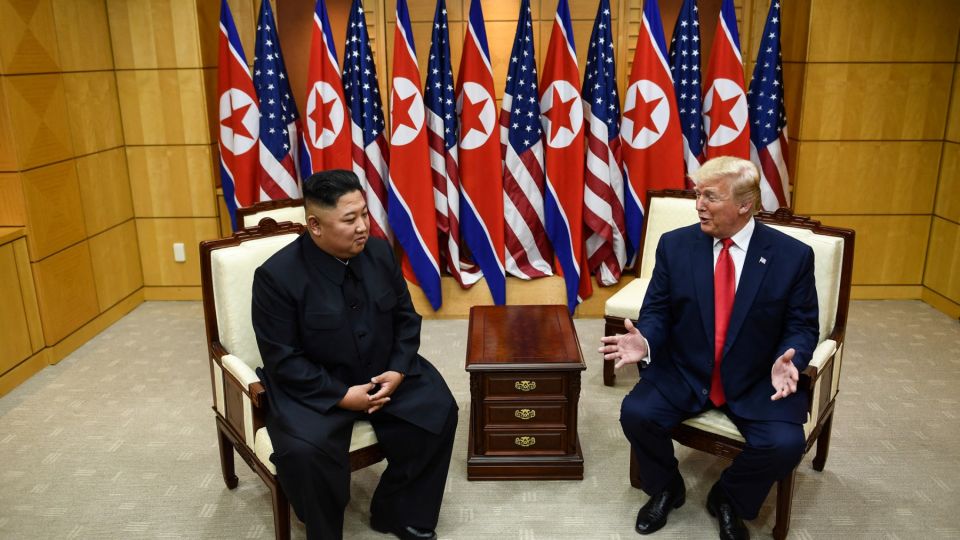
“The likelihood of a renewed leader-level meeting has increased to some extent, with the two leaders sharing common ground, including a mutual desire for a summit, a framework of peaceful coexistence and the relegation of the denuclearization agenda to a later stage,” the report said about a potential Trump-Kim summit.
In particular, US President Trump’s scheduled visit to China in April 2026 could open a window to revive Trump-Kim talks, dormant since June 2019, though such a summit would not necessarily take place in China.
Briefing on their outlook, the authors said Kim’s political calculus would be shaped first and foremost by the scope of potential US sanctions relief, and, secondarily, by progress in President Trump’s bid to end Russia’s war in Ukraine as well as any accompanying shifts in US-Russia relations.
Lee Sang-sook, a professor at IFANS, noted that the “most critical factor is the extent of sanctions relief” in addition to the Russia factor.
“The US can sound out the extent of possible sanctions relief, and if Pyongyang finds it acceptable, US-North Korea dialogue stands a good chance of resuming,” Lee told reporters. “Depending on the substance of discussions between Russia and the US and how the situation surrounding an end to the war in Ukraine unfolds, the chances of North Korea engaging in US-North Korea dialogue would rise compared with this year.”
Echoing that view, Min Jeong-hun, also a professor at IFANS, said that certain signals or messages coming from the US — particularly those suggesting that talks could begin with a nuclear freeze — could be sufficient to revive US-North Korea nuclear diplomacy.
“In that context, the role of the South Korean government is crucial,” Min added, referring to the Lee Jae Myung administration’s role as a “pacemaker.”
The report said that as “South Korea and the US are expected to craft a more realistic denuclearization process for the Korean Peninsula to draw North Korea back to the negotiating table,” the Lee administration’s phased approach could provide a viable roadmap.
“It appears increasingly likely that Washington and Pyongyang could flesh out a mutually acceptable denuclearization approach, potentially anchored in South Korea’s three-stage roadmap: freeze, reduction and dismantlement,” the report said.
The Lee administration’s phased approach departs from negotiations that demand an upfront commitment to the “complete denuclearization of North Korea,” framing denuclearization instead as the result of a step-by-step negotiating process.
“This approach presents gradual denuclearization as a realistic alternative — one in which reductions in North Korea’s nuclear and missile capabilities and corresponding measures are pursued simultaneously and in parallel,” the report added.
However, the report said that “the resumption of inter-Korean talks is unlikely for a considerable period even if North Korea-US dialogue and contact resumes.”
“In 2026, prospects for the resumption of inter-Korean relations remain low due to North Korea’s continued adherence to its ‘hostile two-state doctrine’ and the prolonged Russia-Ukraine war,” the report read.
“With negotiations to terminate Russia’s war in Ukraine expected to remain stalled in 2026, Pyongyang is likely to conclude that improving inter-Korean relations offers limited strategic or economic payoff,” the report read, noting the benefits North Korea has derived from sending troops to support Russia’s war effort.
More broadly, the reemergence of bloc-style confrontation between South Korea, the US and Japan on one side and North Korea, China and Russia on the other appears to have disincentivized North Korea from engaging with South Korea.
Ties between Beijing and Pyongyang have also been on an upward trajectory since the North Korea-China summit in September 2025, with China “reassessing North Korea’s value as a strategic buffer amid intensifying US-China strategic competition.”
“North Korea has found security and economic escape routes within the emerging Eurasian ‘new Cold War’ configuration, as well as through its deepening ties with Russia and China,” the report said.
North Korea will essentially be able to “seek to secure multiple channels for circumventing sanctions by improving relations with China and Russia.”
However, the report also highlighted that Russia-North Korea ties “are projected to shift in line with how long the war in Ukraine persists and how the international community responds.”