

July 15, 2026
DHAKA – Tarin Akter spent Tuesday morning clearing thick layers of mud from the floor of her tin-roofed home in Keochia union of Satkania in Chattogram with a broom and shovel. Around her lay soaked quilts and mattresses, while the mud stove in her kitchen had collapsed after days under water.
Her husband Nasir, an auto-rickshaw driver, returned home on Monday night after spending a week at a relative’s house. “We could not save anything. Most of our belongings have been ruined and will have to be thrown away. It took years to build this household. Replacing everything will be very difficult,” she said.
Across southern Chattogram, floodwaters are gradually receding, but for thousands of families returning home, the scale of devastation is only now becoming clear.
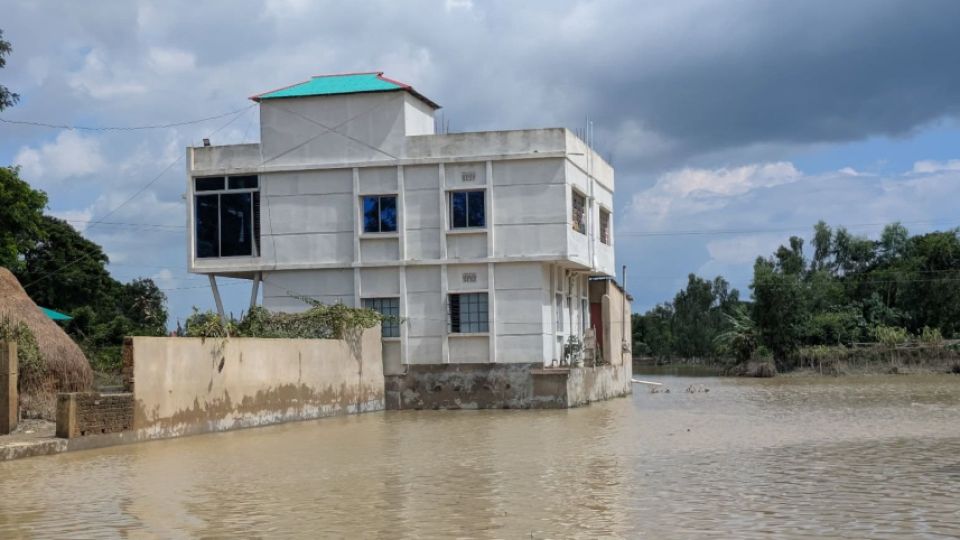
A visit to Keochia, one of the worst-hit unions, found roads and homesteads free of floodwater, though canals, ponds and low-lying fields remained submerged. Homes, businesses and cropland bore the scars of the disaster.
At Trimohoni Bazar, pharmacy owner Abul Kalam Azad was sorting through boxes of medicines damaged by floodwater, estimating losses of Tk 70,000. “I took a loan from Grameen Bank in June to stock my pharmacy. Now most of the medicines are unusable. I don’t know how I will repay the loan,” he said, recalling his losses amounting roughly Tk 1 lakh during the 2023 flood.
For farmer Ahmad Hossain, months of preparation were washed away within hours. Floodwater destroyed an Aman seedbed prepared with 50 kilogrammes of paddy seed and submerged summer vegetables on 80 decimals of land, leaving him with an estimated loss of Tk 25,000. “Now I have to start everything from scratch,” he said.
At Keochia High School, classrooms for classes 9 and 10 on the ground floor were still covered in mud, while water stood in parts of the building. At South Keochia Government Primary School, water continued to cover sections of the ground floor, keeping classrooms closed.
Satkania Upazila Nirbahi Officer Khondaker Mahmudul Hasan said the administration had distributed 15,000 packets of rice and 10,000 packets of dry food among flood-hit families. He noted that some remote areas remained marooned, with more than 100 people still staying at government shelters.
“The flood situation has improved significantly. If there is no further rain, normal life is expected to return within the next two to three days,” he said.
Health authorities warned of continuing risks. Civil Surgeon Dr Jahangir Alam reported rise in waterborne diseases and snakebite cases in Satkania and Banshkhali. Medical teams are providing treatment and monitoring the situation.
The floods have also caused widespread damage to agriculture and fisheries. Official estimates suggest around 14,300 hectares of cropland have been damaged, while nearly 10,000 fish ponds and shrimp enclosures have been affected, causing losses of Tk 109 crore to the fisheries sector alone.