


January 23, 2026
JAKARTA – Sulawesi, the fourth largest island in the country and the 11th largest in the world, made headlines in 2024 thanks to the world’s oldest-known dated cave painting of a wild pig in Maros Pangkep area in South Sulawesi believed to be made around 51,200 years ago.
But researchers recently found that another cave painting found on Muna Island in Southeast Sulawesi, around 300 kilometers from the 2024 discovered painting, might be made even earlier, at least 67,800 years ago.
The latest painting, a hand stencil found at the Liang Metanduno cave, is one of dozens of rock arts found across Muna Island and neighboring Buton Island in Southeast Sulawesi.
Archaeologist Adhi Agus Oktaviana from the National Research and Innovation Agency (BRIN), an author of the study of the Muna rock arts published in Nature on Wednesday, has been exploring Muna since 2015 to look for hand stencils possibly made by ancient humans in the island’s caves.
Adhi later found some hand stencils, including one in Metanduno which was relatively hidden under newer paintings, of a person riding a horse alongside a chicken.
Delivered straight to your inbox three times weekly, this curated briefing provides a concise overview of the day’s most important issues, covering a wide range of topics from politics to culture and society.
The stencil was in a “poor state of conservation”, the researchers noted, with the pigment having faded. Nevertheless, it still showed a portion of the fingers and the adjoining palm area.
“The discussion with my mentor was quite lengthy. We didn’t agree whether these marks were hand stencils,” Adhi said. “But I finally found some spots that looked like human fingers.”
While hand stencils are commonly found across Sulawesi, a special characteristic of the Metanduno rock art is how the tip of one finger appears to have been artificially narrowed, either through the additional application of pigment or by moving the hand when they painted the cave wall.
“As far as I know, it’s the only place in the world where there’s rock art like that. So we’re not sure how they do it,” said archaeologist Maxime Aubert from Griffith University in Australia, who co-led the study.
“And we don’t know why they’re doing this. We think maybe it’s to make them look like an animal hands with claws,” he continued.
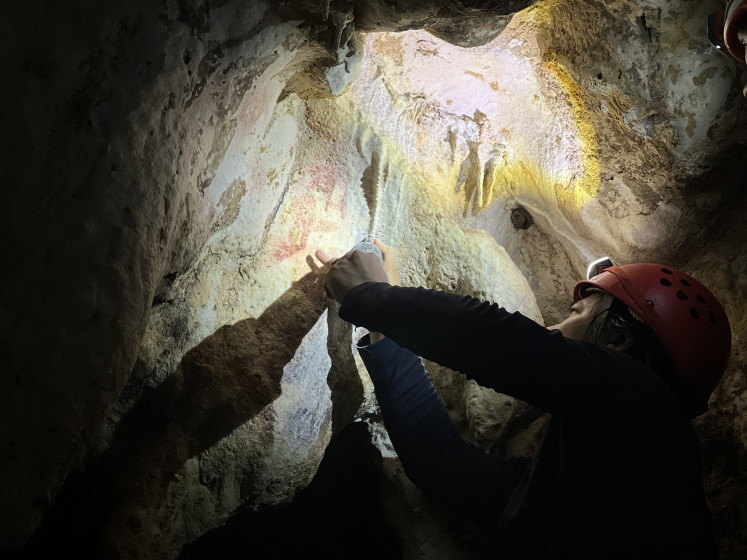
Archeologist Adhi Agus Oktaviana from the National Research and Innovation Agency is seen inspecting a rock art at a cave on Muna Island in South Sulawesi in August 2019. PHOTO: HANDOUT/COURTESY OF MAXIME AUBERT/THE JAKARTA POST
To analyze the earliest possible date of the rock art, Adhi cut a very small piece of the rock where the painting is on.
Aubert and fellow archaeologist Renaud Joannes-Boyau from the Southern Cross University, also in Australia, then performed uranium series analysis on the sample. They particularly looked at the mineral deposit formed on top of the art, which was made using natural pigment made out of ocher, to determine its minimum age.
“When you’re dealing with such a period so far back in time, even having a minimum age is very, very important for us,” said archaeologist Adam Brumm from Griffith University who co-authored the study. “It would be wonderful to know exactly when it was made. But with the limits of the current dating technology, we just can’t tell.”
Paleoanthropologist John Hawks from University of Wisconsin-Madison, the United States, who was not involved in the study, noted the variety of different sites the team investigated in the study, while applying the same approach while dating the samples.
“When you’re using the same approach, you know that this isn’t a special approach that was developed for just one site,” Hawks said. “This is an approach that is capable of finding the accurate ages at whatever site. And the oldest one in this study happens to be really extraordinary.”
While also commending the dating method used in the study, human evolution researcher Dino Mozardien questioned the conclusion drawn by the research team that the Muna rock art was made by early Homo sapiens.
“The researchers argued the technique used to make the stencil was complicated. But it’s actually the same between the one used by Neanderthals and Homo Sapiens,” said Dino, who was also not involved in the study.
“They also argued that the fingers were artificially narrowed. How could they see it when the pigment was so faded?” he continued.
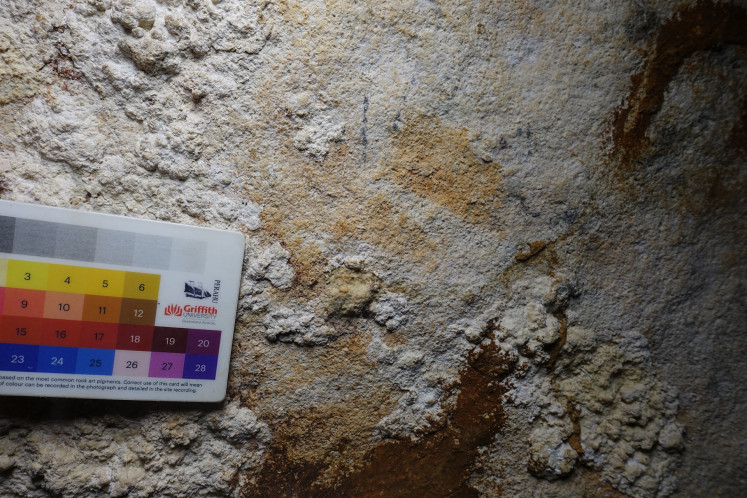
The faded hand stencil that is dated at least 67,800 years old is pointed by a color palette chart held by the archaeologist during an expedition at the Liang Metanduno cave on Muna Island, Southeast Sulawesi in May 2019. PHOTO: HANDOUT/COURTESY OF MAXIME AUBERT/THE JAKARTA POST
Dino suggested the stencil might be made by Denisovans, a subspecies of archaic human ranged across Asia during the Middle to Late Pleistocene around 200,000 to 32,000 years ago. Denisovans, he added, had a similar morphology to Homo sapiens.
While questions on which ancient humans made the Muna Island rock arts might not be able to be answered now, Aubert said the paintings showed the mental capacity of early modern human species that enabled them to make artworks on the cave walls.
The findings also suggested the time and route when early modern humans migrated to Australia through the Sahul paleo continent, making it an important puzzle piece needed to draw the bigger picture of early human migration in the region, Brumm said.
Adhi echoed the sentiments, saying the arts were additional pieces of evidence to show the migration of early humans to Sahul through Sulawesi.
“It also shows that our ancestors were not only great sailors,” Adhi said, “but also artists.”