

May 25, 2026
MANILA – In the Philippines, May is National Heritage Month, thanks to Presidential Proclamation No. 439 signed by former President Gloria Arroyo. It seeks to promote and celebrate the multi-cultural traditions of our people and preserve our country’s identity. It’s when we see museums, woven textiles, centuries-old churches, and historical landmarks highlighted in different events and promotions.
However, heritage is not only found in the halls of museums, ancestral houses, or in every graceful movement of traditional dances. It can also be found on the dining table.
From vinegars and salts to heirloom rice varieties, our country is home to a wide range of ingredients that tell stories about our heritage. They do more than just enhance flavor—they’re a manifestation of our country’s regional identities and culinary history.
This National Heritage Month, let’s take a closer look at these proudly Filipino ingredients.
Fermented ingredients
Fermentation has played a huge role in Filipino kitchens for centuries. Across different regions, Filipinos developed ways of preserving seafood, fruits, rice, and other local produce. Doing so not only extends shelf life but also deepens flavor and makes the most of seasonal harvests.
Take etag as an example. Otherwise known as inasin, etag is a salted slab of pork that is smoked or dried under the sun—or even both—for weeks. The longer it is air-dried and left curing in salt, the more flavorful it is. It is a staple in the Cordilleras and can be bought from local vendors in places like Baguio.
There’s also buro, which also translates to fermented, pickled, or preserved. You’ll encounter different kinds of buro depending on where you are. In Central Luzon, particularly in Pampanga and Pangasinan, you’ll encounter burong isda or burong hipon, which is essentially fermented rice mixed with either fish or shrimp.
If you’re looking for the pickled kind of buro, look for burong mangga and burong mustasa, which are made using brine or vinegar.
Fruits
Given the tropical climate of the Philippines, fruits are plentiful in this country, and many of them can only be found here. One example is sampinit, otherwise known as the Philippine wild raspberry.
Sampinit is hard to come by—not just because they grow in the mountains—but because this fruit can only be harvested once a year. If you’re hoping to get your hands on some, you’ll have to head to the vendors and markets in Laguna and Quezon.
Another example of an indigenous Philippine fruit is batuan, which is also known as binukau. Commonly found in Western Visayas, batuan is green in color and rather small in size, but it packs a punch when it comes to sourness. It’s commonly used for sour dishes, such as sinigang, kansi, or a stew called KBL—an acronym for kadyos, baboy, and langka, the ingredients used to make this dish.
Grains, legumes, and starches
Legumes, along with grains and starches, serve as the backbone of Filipino cuisine. No Filipino meal is ever complete without them. For one thing, kadyos, or pigeon peas in English, is an example of a legume that is part of Philippine heritage.
Kadyos resemble black beans in appearance and have a nutty flavor. Like binukau, kadyos can be found in Visayas, specifically in Antique, Iloilo, Panay Island, and Negros Occidental. You’ll typically find them sold in local markets from October to January when these peas are at their freshest.
As for heirloom grains, one that you will also find in Visayas, specifically in Cebu, is kabog millet. A gluten-free grain, kabog millet has been a staple in the province long before the arrival of the Spaniards. It is typically used to make delicacies such as a steamed yellow-colored cake known as budbud kabog.
Aside from Cebu, heirloom grains are also grown in Mindanao. Adlai, also known as Job’s tears or Chinese pearl barley, is an example of a gluten-free, protein-rich heirloom grain grown in provinces such as Bukidnon and Davao. It can be used for dishes such as arroz caldo and champorado.
There are different varieties of adlai. If you’re looking for the best substitute for white rice, there’s ginampay. If you’re after adlai that can be used for kakanin, look for tapol.
And, of course, no discussion on heirloom grains will ever be complete without those produced in the Cordilleras. The Cordilleras have 428 varieties of traditional heirloom rice grown in the provinces of Ifugao, Kalinga, and Mountain Province.
A common variety of Cordillera heirloom rice is known as tinawon, which is grown in the Ifugao Rice Terraces. Planted and harvested only once annually, tinawon can either be red or white in color and is known for its nutty flavor.
READ: The chefs making uncomplicated food taste even better
Salts
Salt is an essential ingredient that boosts the flavor of many kinds of dishes, including those in Filipino cuisine. While many of these types of salts were introduced to the country due to trade, some are actually proudly Filipino-made.
An example of which is asin tibuok.
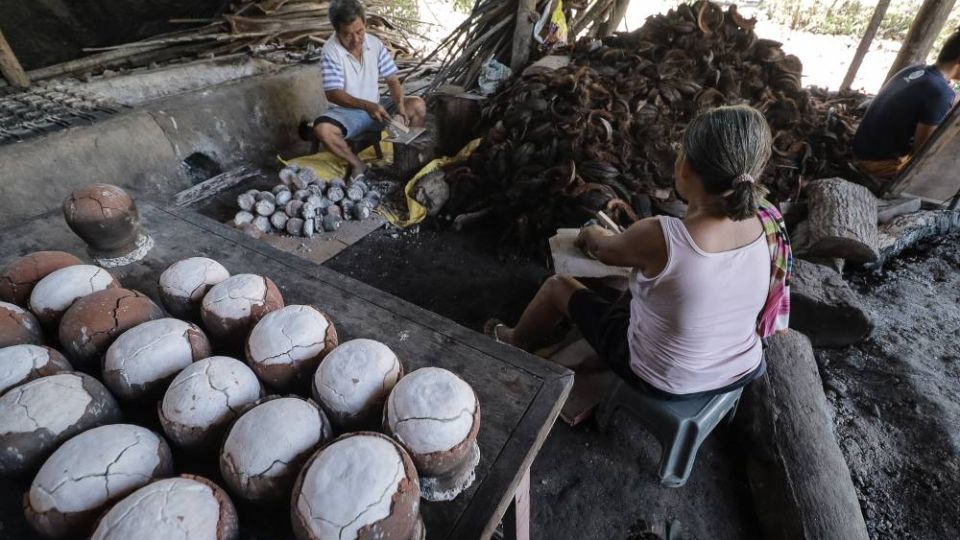
Made in Bohol, asin tibuok is made by soaking coconut husks in seawater for months before they are dried, burned, and mixed with seawater again to create brine called tasik. This is then boiled in clay pots until all that’s left in the pots are the salt. These pots are then cracked to reveal the salt—both of which are sold together in the market.
Another example of locally made salt is asin tultul, which is made in Guimaras. Making asin tultul involves the process of slow-cooking coconut milk, burning driftwood, and filtering seawater. It’s typically sold in solid blocks and has a distinct smoky flavor.
Vinegars
The use of sawsawan during meals is a practice that many Filipinos follow to add extra flavor to what they’re eating. Vinegar, in particular, is a favorite dipping sauce to add a touch of sourness and even spice. Here in the Philippines, different provinces have come up with their own vinegars to complement their food.
Sukang Iloko, as its name suggests, is produced in the Ilocos region and is made from fermented sugarcane juice. It is used both as a condiment and as an ingredient, especially for dishes like kilawin, dinakdakan, and paksiw.
Sukang sasa, on the other hand, is produced in Paombong, Bulacan, which is why it’s also known as sukang paombong. It is made from the fermented sap of the nipa palm tree and does not have the sharp flavor that other vinegars have.
Where to find these heritage ingredients
Getting your hands on heritage ingredients may be easier said than done, especially if you live in Metro Manila and don’t have regular access to markets in the province. But the good news is, it’s not entirely impossible to find these ingredients, especially if you know where to look.
1. Chingolo Deli & Kitchen
Nico Bolzico and Erwan Heussaff’s Chingolo Deli & Kitchen may be best known for steaks, but it also offers a curated selection of pantry staples that include heritage ingredients such as asin tultul and asin tibuok.
You can purchase items in person at their two locations. However, if you don’t have time to drop by, Chingolo also lets you order online, so you can have your items delivered straight to your doorstep.
Chingolo Deli & Kitchen is located at UPRC III, Chino Roces Ave. Ext. Makati City, and at GF, Bldg. 6, Molito Lifestyle Center, Alabang, Muntinlupa. You can reach them through their official website or instagram.com/chingolodeli
2. Echostore
Established in 2008, Echostore champions eco-friendly and natural products as well as a sustainable lifestyle. Their goal is to help small producers, craftsmen, and artisans get their products to markets they wouldn’t have been able to reach.
Echostore offers a wide range of products, including heirloom rice, salts, coconut-based products, and coffee. It also sells home essentials, food supplements, stationery, and pet care products.
Echostore is located at Unit 1B, Ground Floor, Manhattan Square Condo, 162 Valero St., Salcedo Village, Makati City. You can reach them through their official website or instagram.com/echostore
3. Ritual
Ritual describes itself as a “small general store,” but what it brings to the table is anything but small. Ritual sells local, eco-friendly products that are sourced from local producers and are not enclosed in plastic bags.
This is where you can find the likes of kabog millet, kalingag, adlai, sukang Iloko, and many more heritage products. Aside from food, Ritual also sells soaps, essential oils, skincare, cleaning products, and even books. Ritual is located at 5F Karrivin Studios, 2316 Chino Roces Ave. Ext., Makati City. You can reach them through their official website or via instagram.com/ritualph