

January 7, 2026
SEOUL – South Korea and China achieved tangible progress in economic cooperation at Monday’s summit, but Seoul must be cautious of overinterpretation and maintain balance in assessing the current situation, observers say.
According to academics, the meeting must be viewed against the backdrop of years of diplomatic stagnation, with the real measure of success being the improved tone — marking cautious normalization — rather than the number of immediate agreements.
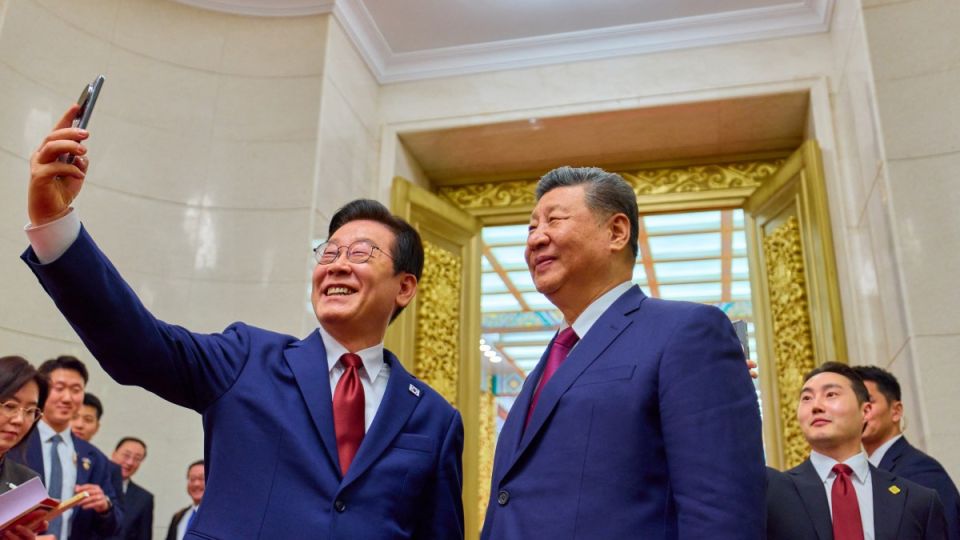
Coming soon after the 2025 APEC meeting hosted by South Korea in Gyeongju, the summit between South Korean President Lee Jae Myung and Chinese leader Xi Jinping “consolidated the momentum toward a full restoration of South Korea–China relations,” national security adviser Wi Sung-lac said in a press briefing after the leaders’ 90-minute discussion.
Choi Jong-kun, an international relations professor at Yonsei University and former first deputy foreign minister, offered a more restrained assessment than Wi, noting that expectations for the meeting should remain measured given the long pause in high-level exchanges that preceded it.
“Especially when looking at summits between South Korea and China, I think there is no need to frame the outcome as a major breakthrough, but also no need to disparage it,” Choi said. “That is because Korea-China relations had been extremely bad to begin with.”
He added that the atmosphere of the meeting itself marked the most important progress.
“There was no excessively meticulous stage-management, no unnecessary tension — it felt plain and unembellished,” Choi said. “After declaring a full restoration, the two countries have in fact now entered the actual path toward normalization.”
Choi suggested that Monday’s agreements — including the signing of 14 government-level memorandums of understanding and more than 30 expected private-sector accords — were useful but secondary to the broader process of rebuilding trust.
Leif-Eric Easley, professor of international studies at Ewha Womans University in Seoul, offered a more reserved assessment, acknowledging Lee’s diplomatic efforts while warning against overinterpretation.
“For South Korea, reestablishing high-level diplomacy with its largest neighbor and trade partner is understandably of strategic importance,” Easley said via email. “Yet despite Seoul’s diplomatic outreach, China has not adopted more internationally responsible policies on maritime disputes or Pyongyang’s nuclear threats.”
He argued that the meeting’s pledges — such as annual leaders’ meetings and continued vice minister-level talks on delimiting maritime economic zones in the West Sea — represent “a useful management framework,” but fall short of a decisive change in Beijing’s regional behavior.
“Ultimately, North Korea’s militarized recalcitrance and China’s economic coercion and naval expansionism call for greater trilateral cooperation among South Korea, Japan, and the United States,” Easley added.
The summit’s references to expanding cultural-content exchanges “gradually and step by step” also drew close scrutiny from experts.
Asked how to understand the clause reaffirming that “peace and stability on the Korean Peninsula are a common interest,” Choi said the statement reflects diplomatic common sense that now carries fresh meaning.
“That message should have been there all along. It has always been the case,” Choi said. “But it feels more significant to us now because inter-Korean relations are at zero and we do not know how US-North Korea relations will unfold.”
The former first deputy foreign minister interpreted the language on cultural exchanges as slightly stronger than expected.
“I think the sentence went one step further than I had expected,” he said. “Because China insists that there is no ban, whereas from our standpoint it is clearly a Hallyu restriction order. But the fact that the two sides agreed to pace-controlled, phased expansion — starting with mutually acceptable areas — means that measures to ease those restrictions have begun to emerge.”
Wi noted in his official briefing that China continues to emphasize that exchanges must be “healthy and mutually beneficial,” and that “it is realistic to start with areas where mutual understanding can be reached and build from there.”
Political parties in Seoul on Tuesday reacted predictably along divided lines, but experts framed the clash as part of the domestic debate over how to manage China relations.
Rep. Song Eon-seog, floor leader of the People Power Party, criticized the summit as “an event-oriented meeting that secured almost no practical diplomatic or security benefits,” pointing to the lack of immediate resolution on Chinese installations in the West Sea and continued ambiguity over the Hallyu ban.
The ruling Democratic Party offered the opposite interpretation. Acting Floor Leader Rep. Moon Jin-seog said the meeting was “an important turning point that reduces uncertainty and enhances predictability under the shared goals of people’s livelihoods and peace,” emphasizing the economic memorandums as proof of success.
Experts, however, stressed that Monday’s Lee-Xi summit was less about winners and losers than about establishing a mechanism to prevent further deterioration.
“The complicated knots were loosened at APEC in Gyeongju and again this week in Beijing,” Choi Jong-kun said. “Now that the declaration has been made, we must watch what kind of real outcomes will appear in 2026.”
Beyond protocol, the factual core remains that Seoul and Beijing agreed to continue talking — annually at the leaders’ level, and within the year on maritime boundaries, illegal fishing, investment negotiations and cultural-exchange details.
Whether this cautious normalization evolves into substantive policy change is a question for experts and officials alike.
But as Wi concluded, “Now that the declaration has been made, we must wait and see what kind of real outcomes will appear in 2026.”